Tattoo inks consist of pigments combined with a carrier and are used in tattooing. Tattoo inks are available in a range of colors that can be thinned or mixed together to produce other colors and shades. Most professional tattoo artists purchase inks pre-made (known as pre-dispersed inks), while some tattooers mix their own using a dry pigment and a carrier.
Tattoo ink is generally permanent. Tattoo removal is difficult, painful, and the degree of success depends on the materials used. Recently developed inks claim to be comparatively easy to remove. Unsubstantiated claims have been made that some inks fade over time, yielding a "semi-permanent tattoo."
A tattoo is a form of body modification made by inserting ink, dyes, and/or pigments, either indelible or temporary, into the dermis layer of the skin to form a design. The art of making tattoos is known as tattooing.
Tattoos comprise three broad categories: purely decorative (with no specific meaning), symbolic (with a specific meaning pertinent to the wearer), and pictorial (a depiction of a specific person or item). In addition, tattoos can be used for identification such as ear tattoos on livestock as a form of branding.
Ink
Yes, ink is what is used to create a tattoo, but is an artist’s least favorite term. Some will refer to their tattoos as ink. In popular culture, ink is thrown around more than you’re likely to hear in real life and most artists won’t refer to anything but the small tubs of colour they’re using in your tattoo as ink.
World
Post Day happens each year on October 9, the anniversary of the Universal
Postal Union (UPU), which started in 1874 in Switzerland. The UPU was the start
of the global communications revolution, introducing the ability to write
letter to others all over the world. World Post Day started in 1969. Since
then, countries all over the world take part in celebrations to highlight the
importance of the postal service. Many things happen on this day. Post offices
in some countries hold special stamp collection exhibitions; there are open
days at postal measures and there are workshops on postal history. The UPU
organises an international letter writing competition for young people.
The
purpose of World Post Day is to create awareness of the role of the postal
sector in people’s and businesses’ everyday lives and its contribution to the
social and economic development of countries. The celebration encourages member
countries to undertake programme activities aimed at generating a broader
awareness of their Post’s role and activities among the public and media on a
national scale.
Every
year, more than 150 countries celebrate World Post Day in a variety of ways. In
certain countries, World Post Day is observed as a working holiday. Many Posts
use the event to introduce or promote new postal products and services. Some
Posts also use World Post Day to reward their employees for good service.
In many
countries, philatelic exhibitions are organized and new stamps and date cancellation
marks are issued. Other activities include the display of World Post Day
posters in post offices and other public places, open days at post offices,
mail centers and postal museums, the holding of conferences, seminars and
workshops, as well as cultural, sport and other recreational activities. Many
postal administrations issue special souvenirs such as T-shirts and badges.
"I
Don't Care" is a song by English singer-songwriter Ed Sheeran and Canadian
singer Justin Bieber. It was released on 10 May 2019. Sheeran previewed the
song on his Instagram on 5 May 2019, and Bieber shared another part of the song
the following day, before both artists announced the full title and release
date on 7 May. It has topped the charts in Australia, the Czech Republic,
Denmark, Finland, Ireland, Italy, the Netherlands, Norway, Scotland, Slovakia,
Sweden, Switzerland, and the United Kingdom.
I'm at a
party I don't wanna be at
And I
don't ever wear a suit and tie
Wonderin'
if I could sneak out the back
Nobody's
even lookin' me in my eyes
Then you
take my hand
Finish
my drink, say, "Shall we dance?" Hell, yeah
You know
I love you, did I ever tell you?
You make
it better like that
Don't
think I fit in at this party
Everyone's
got so much to say, yeah
I always
feel like I'm nobody, mm
Who
wants to fit in anyway?
'Cause I
don't care when I'm with my baby, yeah
All the
bad things disappear
And
you're making me feel like maybe I am somebody
I can
deal with the bad nights
When I'm
with my baby, yeah
Ooh, ooh, ooh, ooh,
ooh, ooh
'Cause I
don't care, as long as you just hold me near
You can
take me anywhere
And
you're making me feel like I'm loved by somebody
I can
deal with the bad nights
When I'm
with my baby, yeah
Ooh, ooh, ooh, ooh,
ooh, ooh
We at a
party we don't wanna be at
Tryna
talk, but we can't hear ourselves
Read
your lips, I'd rather kiss 'em right back
With all
these people all around
I'm
crippled with anxiety
But I'm
told it's where I'm supposed to be
You know
what? It's kinda crazy 'cause I really don't mind
And you
make it better like that
Don't
think we fit in at this party
Everyone's
got so much to say, oh yeah, yeah
When we
walked in, I said I'm sorry, mm
But now
I think that we should stay
'Cause I
don't care when I'm with my baby, yeah
All the
bad things disappear
Yeah,
you're making me feel like maybe I am somebody
I can
deal with the bad nights when I'm with my baby, yeah
The
Grand Final of Eurovision Song Contest 2019 took place live from Tel Aviv,
where 26 countries competed for the trophy, and the honor of hosting next
year's Eurovision Song Contest
After
3,5 hours of music, performances, entertainment and excitement, Duncan Laurence
from the Netherlands was crowned as the winner of the 64th Eurovision Song Contest
with the song Arcade.
It's the
fifth time the Netherlands wins Eurovision. Last time was in Eurovision Song
Contest 1975 where Teach-In won with "Ding-A-Dong".
Duncan
Laurence won the Eurovision Song Contest 2019, in Tel Aviv, Israel with 492
points from 41 International Juries and the Public Vote. The Juries gave him
231 points, while the Public Vote got him 261 points. He was ahead of Italy
with 465 points. Personal
life
In a
press conference shortly before the Eurovision final, Laurence came out as
bisexual: "I am more than just an artist, I am a person, I am a living
being, I’m bisexual, I’m a musician, I stand for things. And I’m proud that I
get the chance to show what I am, who I am.”
The death of the Hollywood icon, who was best known for her film work in the late 50s and 60s and her hit song Que Sera Seraw, as announced by her foundation today.
I think
most of you have seen the movie Bohemian Rhapsody with Rami Malek as Freddie
Mercury. The film premiered in London on October 23, 2018, and became a major
box office success, grossing over $879 million worldwide on a production budget
of about $50 million. It became the sixth highest-grossing film of 2018
worldwide, and the highest-grossing musical biographical film of all-time.
Despite mixed reviews for the film itself, Malek's performance received
critical acclaim. He won a Golden Globe for Best Actor in a Motion Picture
Drama, the Screen Actors Guild Award for Outstanding Performance by a Male Actor
in a Leading Role, the BAFTA Award for Best Actor in a Leading Role and the
Academy Award for Best Actor for his performance in the film.
Freddie Mercury and Rami Malek
To
prepare for the role as Mercury, Malek moved to London where he employed a
dialect coach and movement coach and took piano and singing lessons. For four
hours each day, he studied videos of Mercury with his movement coach, Polly
Bennett. This included watching the 1985 Live Aid concert video on YouTube at
least 1,500 times to perfect his performance for the movie. He also had to get
used to singing and speaking with a set of false teeth that mimicked the
singer's overbite. Brian May, Queen's guitarist who often attended filming, is
quoted as saying that Malek's performance was so accurate that "we
sometimes forgot he was Rami".
Rami and his brother Sami
Rami
Said Malek was born in Los Angeles, on May 12, 1981, to Egyptian immigrant
parents, Said Malek and Nelly Abdel-Malek. He has said he is also "an
eighth Greek". His parents left Cairo in 1978 after his father, a tour
guide, became intrigued with Western visitors. They settled in Sherman Oaks,
Los Angeles, mostly staying in the San Fernando Valley and rarely venturing
into Hollywood. His father sold insurance; his mother is an accountant. Malek
was raised in his family's Coptic Orthodox Christian faith and grew up speaking
colloquial Egyptian Arabic at home until the age of four. Malek has an
identical twin brother named Sami who is younger by four minutes; he is an ESL
and English teacher. Malek's older sister, Yasmine, is an ER doctor.
Malek
studied at Notre Dame High School in Sherman Oaks, California. Future actresses
Kirsten Dunst and Rachel Bilson also studied at the same school. Later, he
studied at University of Evansville, in Evansville, Indiana. He graduated in
2003 with a Bachelor of Fine Arts degree.
Rami Malek
began his acting career playing guest roles in the TV series ‘Gilmore Girls’,
‘Over There’ and ‘Medium’. His important role was in the American sitcom ‘The
War at Home’ (2005–07). It ran for two seasons, earning mostly mixed reviews.
He made
his film debut in 2006 with a supporting role in the comedy fantasy film ‘Night
at the Museum’. He played the role of Pharaoh Ahkmenrah and reprised his role
in the movie’s sequel ‘Night at the Museum: Battle of the Smithsonian’ in 2009.
Both the films were commercially successful.
He
reprised his role of Pharaoh Ahkmenrah in ‘Night at the Museum: Secret of the
Tomb,’ the third installment of the ‘Night at the Museum’ film series, in 2014.
The
Metropolitan Museum of Art of New York City, colloquially "the Met",
is the largest art museum in the United States. With 6,953,927 visitors to its
three locations in 2018, it was the third most visited art museum in the world.
Its permanent collection contains over two million works, divided among
seventeen curatorial departments. The main building, on the eastern edge of
Central Park along Museum Mile in Manhattan's Upper East Side is by area one of
the world's largest art galleries. A much smaller second location, The
Cloisters at Fort Tryon Park in Upper Manhattan, contains an extensive
collection of art, architecture, and artifacts from Medieval Europe. On March
18, 2016, the museum opened the Met Breuer museum at Madison Avenue on the
Upper East Side; it extends the museum's modern and contemporary art program.
History
The New
York State Legislature granted the Metropolitan Museum of Art an Act of
Incorporation on April 13, 1870"for the purpose of establishing and
maintaining in said City a Museum and Library of Art, of encouraging and
developing the Study of the Fine Arts, and the application of Art to
manufacture and natural life, of advancing the general knowledge of kindred
subjects, and to that end of furnishing popular instruction and
recreations". This legislation was supplemented later by the 1893 Act,
Chapter 476, which required that its collections "shall be kept open and
accessible to the public free of all charge throughout the year." The
founders included businessmen and financiers, as well as leading artists and
thinkers of the day, who wanted to open a museum to bring art and art education
to the American people.
The Great Hall
The
permanent collection consists of works of art from classical antiquity and
ancient Egypt, paintings, and sculptures from nearly all the European masters,
and an extensive collection of American and modern art. The Met maintains
extensive holdings of African, Asian, Oceanian, Byzantine, and Islamic art. The
museum is home to encyclopedic collections of musical instruments, costumes,
and accessories, as well as antique weapons and armor from around the world.
Several notable interiors, ranging from 1st-century Rome through modern
American design, are installed in its galleries.
The
Metropolitan Museum of Art was founded in 1870 for the purposes of opening a
museum to bring art and art education to the American people. It opened on
February 20, 1872, and was originally located at 681 Fifth Avenue.
Wim
Mertens (born 14 May 1953) is a Flemish Belgian composer, countertenor
vocalist, pianist, guitarist, and musicologist. Mertens'
style has continually evolved during the course of his prolific career,
starting from downright experimental and avant-garde, always gravitating around
minimalism, usually, however, preserving a melodic foundation to the forays
that he makes into the worlds that he is exploring. His compositional quality
has often overweighted the "labelling issue" and reached wider
audiences although stemming from a far-from-mainstream musical.
Maximizing The Audience is the first solo
release of Belgian multi-instrumentalist and composer Wim Mertens, after he
dropped the group name Soft Verdict. The album was composed for the play The
Power of Theatrical Madness by Jan Fabre and premiered in Venice on June 11,
1984
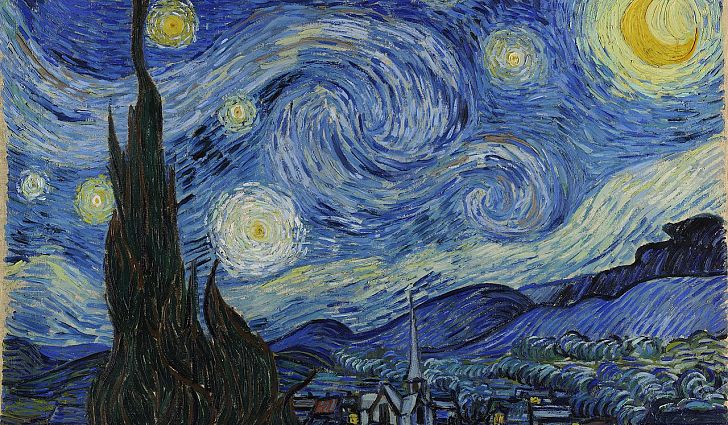
Vincent
Willem van Gogh 30 March 1853 – 29 July 1890 was a Dutch Post-Impressionist
painter who is among the most famous and influential figures in the history of
Western art. In just over a decade he created about 2,100 artworks, including
around 860 oil paintings, most of them in the last two years of his life. They
include landscapes, still lifes, portraits and self-portraits, and are
characterised by bold colours and dramatic, impulsive and expressive brushwork
that contributed to the foundations of modern art. However, he was not
commercially successful, and his suicide at 37 followed years of mental illness
and poverty.
Born
into an upper-middle-class family, Van Gogh drew as a child and was serious,
quiet and thoughtful. As a young man he worked as an art dealer, often
travelling, but became depressed after he was transferred to London. He turned
to religion and spent time as a Protestant missionary in southern Belgium. He
drifted in ill health and solitude before taking up painting in 1881, having
moved back home with his parents. His younger brother Theo supported him
financially, and the two kept up a long correspondence by letter. His early
works, mostly still lifes and depictions of peasant labourers, contain few
signs of the vivid colour that distinguished his later work. In 1886, he moved
to Paris, where he met members of the avant-garde, including Émile Bernard and
Paul Gauguin, who were reacting against the Impressionist sensibility. As his
work developed, he created a new approach to still lifes and local landscapes.
His paintings grew brighter in colour as he developed a style that became fully
realised during his stay in Arles in the south of France in 1888. During this period,
he broadened his subject matter to include series of olive trees, wheat fields
and sunflowers.
Van Gogh
suffered from psychotic episodes and delusions and though he worried about his
mental stability, he often neglected his physical health, did not eat properly
and drank heavily. His friendship with Gauguin ended after a confrontation with
a razor, when in a rage, he severed part of his own left ear. He spent time in
psychiatric hospitals, including a period at Saint-Rémy. After he discharged
himself and moved to the Auberge Ravoux in Auvers-sur-Oise near Paris, he came
under the care of the homeopathic doctor Paul Gachet. His depression continued
and on 27 July 1890, Van Gogh shot himself in the chest with a revolver. He
died from his injuries two days later.
Van Gogh
was unsuccessful during his lifetime and was considered a madman and a failure.
He became famous after his suicide and exists in the public imagination as the
quintessential misunderstood genius, the artist "where discourses on
madness and creativity converge". His reputation began to grow in the
early 20th century as elements of his painting style came to be incorporated by
the Fauves and German Expressionists. He attained widespread critical,
commercial and popular success over the ensuing decades, and is remembered as
an important but tragic painter, whose troubled personality typifies the
romantic ideal of the tortured artist. Today, Van Gogh's works are among the world's
most expensive paintings to have ever sold at auction, and his legacy is
honoured by a museum in his name, the Van Gogh Museum in Amsterdam, which holds
the world's largest collection of his paintings and drawings.
In general, kung fu/kungfu or gung
fu/gongfu or /ˌkʊŋˈfuː/; 功夫, Pinyin: gōngfu)
refers to the Chinese martial arts, also called wushu and quanfa. In China, it
refers to any study, learning, or practice that requires patience, energy, and
time to complete. In its original meaning, kung fu can refer to any discipline
or skill achieved through hard work and practice, not necessarily martial arts.
The Chinese literal equivalent of "Chinese martial art" would be 中國武術 zhōngguó wǔshù.
There are many forms of kung fu, namely
Shaolin Kung Fu, Wing Chun, Tai chi, etc. and are practiced all over the world.
Each form of kung fu has its own principles and techniques. It is only in the
late twentieth century, that this term was used in relation to Chinese martial
arts by the Chinese community. The Oxford English Dictionary defines the term
"kung-fu" as "a primarily unarmed Chinese martial art resembling
karate." This illustrates how the meaning of this term has been changed in
English. The origin of this change can be attributed to the misunderstanding or
mistranslation of the term through movie subtitles or dubbing.
In
modern times, Chinese martial arts have spawned the genre of cinema known as
the Kung fu film. The films of Bruce Lee were instrumental in the initial burst
of Chinese martial arts' popularity in the West in the 1970s. Bruce Lee was the
iconic international superstar that popularized Chinese martial arts in the
West. The influence of Chinese martial art has been widely recognized and have
a global appeal in Western cinemas starting off with Bruce Lee.
Martial
artists and actors such as Jet Li and Jackie Chan have continued the appeal of
movies of this genre. Jackie Chan successfully brought in a sense of humour in
his fighting style in his movies. Martial arts films from China are often
referred to as "kung fu movies" (功夫片), or
"wire-fu" if extensive wire work is performed for special effects and
are still best known as part of the tradition of kung fu theater. The talent of
these individuals has broadened Hong Kong's cinematography production and rose
to popularity overseas, influencing Western cinemas.
In the
west, kung fu has become a regular action staple, and makes appearances in many
films that would not generally be considered "Martial Arts" films.
These films include but are not limited to The Matrix Trilogy, Kill Bill, and
The Transporter.
Martial
arts themes can also be found on television networks. A U.S. network TV western
series of the early 1970s called Kung Fu also served in an attempt to
mainstream the Chinese martial arts on television. With 60 episodes over a
three-year span, it was one of the first North American TV shows that tried to
convey the philosophy and practice in Chinese martial arts. The use of Chinese
martial arts techniques can now be found in most TV action series, although the
philosophy of Chinese martial arts is seldom portrayed in depth.
Influence
on Hip Hop
In the
1970s, Bruce Lee was beginning to gain popularity in Hollywood for his martial
arts movies. The fact that he was a non-white male who portrayed self-reliance
and righteous self-discipline resonated with black audiences and made him an
important figure in this community. Around 1973, Kung Fu movies became a hit in
America across all backgrounds; however, black audiences maintained the films’
popularity well after the general public lost interest. Urban youth in New York
City were still going from every borough to Times Square every night to watch
the latest movies. Amongst these individuals were those coming from the Bronx
where, during this time, hip-hop was beginning to take form. One of the
pioneers responsible for the development of the foundational aspects of hip-hop
was DJ Kool Herc, who began creating this new form of music by taking rhythmic
breakdowns of songs and looping them. From the new music came a new form of
dance known as b-boying or breakdancing, a style of street dance consisting of
improvised acrobatic moves. The pioneers of this dance credit kung fu as one of
its influences. Moves such as the crouching low leg sweep and “up rocking”
(standing combat moves) are influenced by choreographed kung-fu fights. The
dancers’ ability to improvise these moves led way to battles, which were dance
competitions between two dancers or crews judged on their creativity, skills
and musicality. In a documentary, Crazy Legs, a member of breakdancing group
Rock Steady Crew, described the breakdancing battle being like an old kung fu
movie, “where the one kung fu master says something along the lines of ‘hun
your kung fu is good, but mine is better,’ then a fight erupts.”
Motown Records is an American record label owned by
Universal Music Group. It was originally founded by Berry Gordy Jr. as Tamla
Records on January 12, 1959 and was incorporated as Motown Record Corporation
on April 14, 1960. Its name, a portmanteau of motor and town, has become a
nickname for Detroit, where the label was originally headquartered.
Berry Gordy Jr. 2018
Motown played an important role in the racial
integration of popular music as an African American-owned label that achieved
significant crossover success. In the 1960s, Motown and its subsidiary labels
(including Tamla Motown, the brand used outside the US) were the most
successful proponents of what came to be known as the Motown Sound, a style of
soul music with a distinct pop influence. During the 1960s, Motown achieved
spectacular success for a small label: 79 records in the top-ten of the
Billboard Hot 100 between 1960 and 1969. Following the events of the Detroit
Riots of 1967 and the loss of key songwriting/production team
Holland-Dozier-Holland the same year over pay disputes, Gordy began relocating
Motown to Los Angeles, California. The move was completed in 1972, and Motown
later expanded into film and television production, remaining an independent
company until 1994, when it was sold to PolyGram before being sold again to MCA
Records' successor Universal Music Group when it acquired PolyGram in 1999.
Motown spent much of the 2000s headquartered in New
York City as a part of the UMG subsidiaries Universal Motown and Universal
Motown Republic Group. From 2011 to 2014, it was a part of The Island Def Jam
Music Group division of Universal Music. In 2014, however, UMG announced the
dissolution of Island Def Jam, and Motown relocated back to Los Angeles to
operate under the Capitol Music Group, now operating out of the landmark
Capitol Tower. In 2018, Motown was inducted into Rhythm & Blues Hall of
Fame class at the Charles H. Wright Museum, and Motown legend Martha Reeves
received the award for the label.
History
Berry Gordy got his start as a songwriter for local
Detroit acts such as Jackie Wilson and the Matadors. Wilson's single
"Lonely Teardrops", written by Gordy, became a huge success, but
Gordy did not feel he made as much money as he deserved from this and other
singles he wrote for Wilson. He realized that the more lucrative end of the
business was in producing records and owning the publishing.
In 1959, Billy Davis and Berry Gordy's sisters Gwen
and Anna started Anna Records. Davis and Gwen Gordy wanted Berry to be the
company president, but Berry wanted to strike out on his own. On January 12,
1959, he started Tamla Records, with an $800 loan from his family and royalties
earned writing for Jackie Wilson. Gordy originally wanted to name the label
Tammy Records, after the hit song popularized by Debbie Reynolds from the 1957
film Tammy and the Bachelor, in which Reynolds also starred. When he found the
name was already in use, Berry decided on Tamla instead. Tamla's first release,
in the Detroit area, was Marv Johnson's "Come to Me" in 1959
(released nationally on United Artists). Its first hit was Barrett Strong's
"Money (That's What I Want)" (1959), which made it to number 2 on the
Billboard R&B charts (released nationally on Anna Records).
We not had much guests but for Mr. Mikey that was no problem and he we all had a great time listen and dance on the great songs he sang. And you all missed it.