Showing posts with label Love Cats. Show all posts

Wednesday, November 27, 2013

PET chapter III

On August 29, 2013 we had a CATS & DOGS PARTY at T.R.A.C.S.
I not want to repeat my self with cat and dogs songs:
But I want to mention:
Pet Sounds
Pet Sounds is the eleventh studio album by the American rock band the Beach Boys, released May 16, 1966, on Capitol Records. It has since been recognized as one of the most influential records in the history of popular music and one of the best albums of the 1960s, including songs such as "Wouldn't It Be Nice" and "God Only Knows". Pet Sounds was created several months after Brian Wilson had quit touring with the band in order to focus his attention on writing and recording. In it, he wove elaborate layers of vocal harmonies, coupled with sound effects and unconventional instruments such as bicycle bells, buzzing organs, harpsichords, flutes, Electro-Theremin, dog whistles, trains, Hawaiian-sounding string instruments, Coca-Cola cans and barking dogs, along with the more usual keyboards and guitars.

Although Pet Sounds was met with strong sales abroad, reaching number two in the UK, it charted lower in the US than the majority of the band's preceding albums, peaking at number ten on the Billboard 200. A heralding album in the emerging psychedelic rock style, Pet Sounds has been championed and emulated for its dramatic and revolutionary baroque pop instrumentation. It has been ranked at number one in several music magazines' lists of greatest albums of all time, including NME, The Times and Mojo Magazine. It was ranked number two in Rolling Stone's 500 Greatest Albums of All Time list. It was preserved into the National Recording Registry in 2004 by the Library of Congress for being "culturally, historically, and aesthetically significant."
Cover photo and title meaning
On February 15, the group traveled to the San Diego Zoo to shoot the photographs for the cover, which had already been titled Pet Sounds. George Jerman has been credited for taking the cover photo. According to the Pet Sounds' liner notes, "The photos of The Beach Boys feeding an assortment of goats was a play on the album's chosen title, Pet Sounds."
Both the origin and meaning of the album title Pet Sounds are uncertain. Brian Wilson has claimed at one point that the title was "a tribute" to Phil Spector by naming the album using his initials. Carl Wilson later spoke about the album title: "The idea he had was that everybody has these sounds that they love, and this was a collection of his 'pet sounds.' It was hard to think of a name for the album, because you sure couldn't call it Shut Down Vol. 3."

Mike Love also has laid claim to coming up with the title. "We were standing in the hallway in one of the recording studios, either Western or Columbia, and we didn't have a title," he recounted. "We had taken pictures at the zoo and ... there were animal sounds on the record, and we were thinking, well, it's our favorite music of that time, so I said, 'Why don't we call it Pet Sounds?'"

The Beach Boys- Pet Sounds
Vespasius Cracescu made this video and wrote:
"A tribute I made for one of my favorite albums."

Tuesday, November 26, 2013

PET chapter I

A pet (or companion animal) is an animal kept primarily for a person's company or protection, as opposed to working animals, sport animals, livestock, and laboratory animals, which are kept primarily for performance, agricultural value, or research. The most popular pets are noted for their attractive appearances and their loyal or playful personalities.
Pets commonly provide their owners (or guardians) physical and emotional benefits. Walking a dog can supply both the human and pet with exercise, fresh air, and social interaction. Pets can give companionship to elderly adults who do not have adequate social interaction with other people. There is a medically approved class of therapy animals, mostly dogs, that are brought to visit confined humans. Pet therapy utilizes trained animals and handlers to achieve specific physical, social, cognitive, and emotional goals with patients.

The most popular pets are likely dogs and cats, but people also keep house rabbits; rodents such as gerbils, hamsters, chinchillas, fancy rats, and guinea pigs; avian pets, such as canaries, parakeets, and parrots; reptile pets, such as turtles, lizards and snakes; aquatic pets, such as tropical fish and frogs; and arthropod pets, such as tarantulas and hermit crabs.

Some scholars and animal rights organizations have raised concern over pet-keeping with regards to the autonomy of nonhuman animals.
 
Etymology
Originally from Northern English and Scots dialects, origin is unsure but may have arisen due to influence of petty pertaining to children and later companion animals. Almost certainly of Germanic etymology.

Noun
pet (plural pets)
 1.An animal kept as a companion.
 2.One who is excessively loyal to a superior.
 3.Any person or animal especially cherished and indulged; a darling.

Common types
While many people have kept many different species of animals in captivity over the course of human history, only a relative few have been kept long enough to be considered domesticated. Other types of animals, notably monkeys, have never been domesticated but are still commonly sold and kept as pets. There are also inanimate objects that have been kept as "pets", either as a form of game, or humorously (e.g. the pet rock or Chia pet).

Domesticated
Domesticated pets are the most common types of pet. A domesticated animal is any animal that has been tamed and made fit for a human environment. They have consistently been kept in captivity over a long enough period of time that they exhibit marked differences in behavior and appearance from their wild relatives.
Mammals
 Alpacas
 Asses including miniature donkeys
 Cats
 Dogs
 Sheep
 Horses
 Goats
 Elephants
 Rodents including Fancy rats, Fancy mice, Hamsters, Guinea pigs, and Chinchillas
 Ferrets
 Llamas
 Pigs
 Rabbits

Birds
 Domestic Canary
 Chickens
 Domestic turkeys
 Domestic ducks and geese
 Domestic Pigeons and Doves

Fish
 Goldfish
 Koi
 Siamese fighting fish

Tuesday, August 27, 2013

CATS & DOGS chapter II

Classic Rock & Pop Songs about Dogs and Cats
A small selection

How Much Is That Doggie In The Window? by Patti Page
"How Much Is That Doggie in the Window?" is a popular novelty song published as having been written by Bob Merrill in 1952 and very loosely based on the folk tune, Carnival of Venice. The best-known version of the song was the original, recorded by Patti Page on December 18, 1952 and released in January 1953 by Mercury

Year Of The Cat, by Al Stewart
"Year of the Cat" is the seventh studio album by Al Stewart, released in 1976 and engineered by Alan Parsons; it is considered his masterpiece, its sales helped by the hit single "Year of the Cat", "one of those 'mysterious woman' songs," co-written by Peter Wood. The other single from the album was "On the Border". Stewart wrote "Lord Grenville" about the Elizabethan sailor and explorer Sir Richard Grenville (1542–1591).

Cat Scratch Fever, by Ted Nugent
"Cat Scratch Fever" (1977) is the third studio album by American guitarist Ted Nugent and his band, as well as the name of the album's title song. Vocalist Derek St. Holmes, who had left the band during the recording of the album Free-for-All, had come back for touring in 1976 and was again the lead singer on this album.

Black Dog, by Led Zeppelin
"Black Dog" is a song by English rock band Led Zeppelin, the opening track on their fourth album (1971). It was released as a single in the U.S.A and in Australia with "Misty Mountain Hop" as the B-side, reaching #15 on Billboard and #11 in Australia.
In 2010, the song was ranked #300 on Rolling Stone's list of the 500 Greatest Songs of All Time. Music sociologist Deena Weinstein calls "Black Dog" "one of the most instantly recognisable Led Zeppelin tracks".

Cat's In The Cradle, by Harry Chapin
"Cat's in the Cradle" is a 1974 folk rock song by Harry Chapin from the album Verities & Balderdash. The single topped the Billboard Hot 100 in December 1974 and also peaked at number six on the Easy Listening chart. As Chapin's only #1 hit song, it became the best known of his work and a staple for folk rock music.

The Love Cats, by The Cure
"The Love Cats" is a 1983 single by The Cure. It was the band's first Top 10 hit in the UK, peaking at number seven, and also hit number six in Australia. It later appeared on the compilation album Japanese Whispers. The original UK-only single appears to list the title as "The Lovecats", as do various compilations.

I love my dog. by Cat Stevens
"I Love My Dog" is a song written by Cat Stevens, and it was his first single (b/w "Portobello Road"), showing up on his debut album, Matthew and Son. Stevens later acknowledged that the song has been inspired by Yusef Lateef's "The Plum Blossom" (from Eastern Sounds) with which it shares a melody.

Wednesday, May 2, 2012

Love Cats 3

Cats are fun
▲▼I do not know why these two pictures remind me of Tim and Rod.

Love Cats 2

I Love My Cats
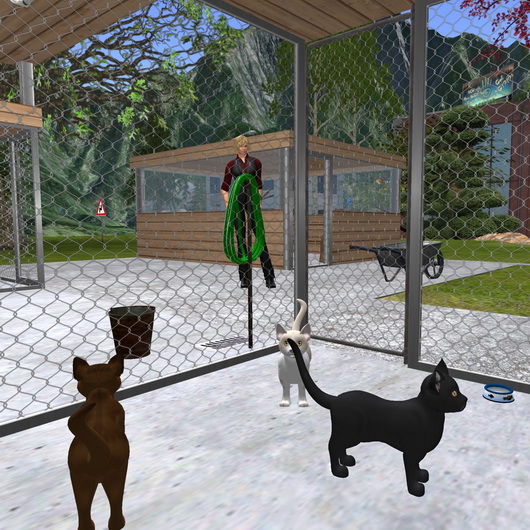
For some time I wanted to publish an article about our cats. Dillon gave us our first cats and we kept them. I started to breed with them but never became a big breeder. 
Here some pictures of the cattery.
Our cats are from WildWood Breedables. I never did read the Wildwood website frequently and neither I followed blogs about/of cat breeders till the WildWood sim was no longer accessible. So after a short search I read this:
Thank you, Tracy Sparrowtree.
 So it will be unsure what happen with the WW Kittys in the near future.

Love Cats 1


"The Love Cats" is a 1983 single by The Cure. It was the band's first Top 10 hit in the UK, peaking at number seven, and also hit number six in Australia. It later appeared on the compilation album Japanese Whispers.
At the time the song was written, Robert Smith was very interested in the work of Australian author, Patrick White. According to a number of his fans, Smith was inspired to write "The Love Cats" after reading White's novel, The Vivisector (1970), although this claim is difficult to verify.

In the novel, the protagonist, Hurtle, is appalled when his lover's husband drowns a sack of stray cats. White draws a parallel between the way in which the cats are discarded, and the treatment of certain characters in the book; by extension, the cats symbolize the most innocent and vulnerable members of society, and the casual cruelty with which they sometimes meet their fate.

Patrick Victor Martindale White (28 May 1912 – 30 September 1990), was an Australian author, widely regarded as an important English-language novelist of the 20th century. From 1935 until his death, he published 12 novels, two short-story collections and eight plays.

White's fiction employs humour, florid prose, shifting narrative vantage points and a stream of consciousness technique. In 1973, he was awarded the Nobel Prize in Literature—and was the only Australian citizen to have been awarded the Literature prize until the South African-born J. M. Coetzee became an Australian citizen in 2006. The Vivisector, a novel about the life and times of a successful modernist painter, was shortlisted for the Lost Man Booker Prize in 2010.

The Vivisector is the eighth published novel by Patrick White. First published in 1970, it details the lifelong creative journey of fictional artist/painter Hurtle Duffield. Named for its sometimes cruel analysis of Duffield and the major figures in his life, the book explores universal themes like the suffering of the artist, the need for truth and the meaning of existence.

Plot summary
Hurtle Duffield is born into a poor Australian family. They adopt him out to the wealthy Courtneys, who are seeking a companion for their hunchbacked daughter Rhoda. The precocious Hurtle gains artistic inspiration from the world that surrounds him, his adoptive mother, Maman, and Rhoda; the prostitute Nance, who is his first real love; the wealthy heiress Olivia Davenport; his Greek mistress Hero Pavloussi and finally the child prodigy Kathy Volkov. He becomes famous and his paintings are in great demand. However, he is unimpressed by the monetary and status gain this brings and continues to live a spartan life, beholden to nobody - even the Prime Minister. In his final years he is drawn closer to his sister Rhoda, and after a stroke causes partial paralysis, is assisted by his protoge Don Lethbridge to produce a huge, final magnum opus to God--the Vivisector.

The Cure are an English rock band formed in Crawley, West Sussex in 1976. The band has experienced several line-up changes, with frontman, vocalist, guitarist and principal songwriter Robert Smith being the only constant member. The Cure first began releasing music in the late 1970s with its debut album Three Imaginary Boys (1979); this, along with several early singles, placed the band as part of the post-punk and New Wave movements that had sprung up in the wake of the punk rock revolution in the United Kingdom. During the early 1980s, the band's increasingly dark and tormented music helped form the gothic rock genre. 
Source: Wikipedia

The Lovecats Lyrics

We move like cagey tigers
 Oh we couldn't get closer than this
 The way we walk
 The way we talk
 The way we stalk
 The way we kiss
 We slip through the streets
 While everyone sleeps
 Getting bigger and sleeker
 And wider and brighter
 We bite and scratch and scream all night
 Let's go and throw
 All the songs we know...

Into the sea
 You and me
 All the years and no one heard
 I'll show you in spring
 It's a treacherous thing
 We missed you hissed the lovecats
 We missed you hissed the lovecats

We're so wonderfully wonderfully wonderfully
 Wonderfully pretty!
 Oh you know that I'd do anything for you...
 We should have each other to tea huh?
 We should have each other with cream
 Then curl up in the fire
 And sleep for awhile
 It's the grooviest thing
 It's the perfect dream

Into the sea
 You and me
 All the years and no one heard
 I'll show you in spring
 It's a treacherous thing
 We missed you hissed the lovecats
 We missed you hissed the lovecats
 We missed you hissed the lovecats
 We missed you hissed the lovecats

We're so wonderfully wonderfully wonderfully
 Wonderfully pretty!
 You know that i'd do anything for you...
 We should have each other to dinner
 We should have each other with cream
 Then curl up in the fire
 Get out for awhile
 It's the grooviest thing
 It's the perfect dream

Hand in hand
 Is the only way to land
 And always the right way round
 Not broken in pieces
 Like hated little meeces...
 How could we miss
 Someone as dumb as this?
 We missed you hissed the lovecats

I love you... let's go...
 Oh... solid gone...
 How could we miss
Someone as dumb as this?