Showing posts with label Ice Cream. Show all posts

Friday, June 21, 2013

ICE CREAM PARTY @ T.R.A.C.S

I scream, you scream, we all scream for Ice Cream......................................................... 
Harbor at River Island
ICE CREAM chapter III

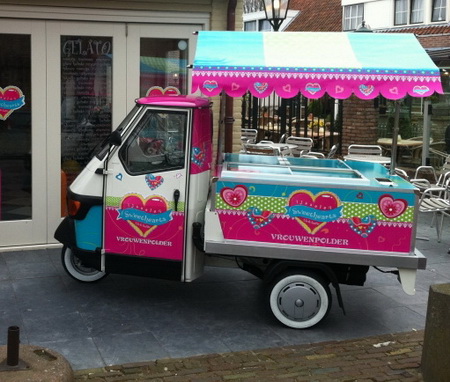
Ice Cream Truck
An ice cream van (British) or ice cream truck (American) is a commercial vehicle which serves as a traveling retail outlet for ice cream, usually during the summer. Ice cream vans are often seen parked at public events, or near parks, beaches, or other areas where people congregate. Ice cream vans often travel near where children play — outside schools, in residential areas, or in other locations. They usually stop briefly before moving on to the next street.

There were many stages of mobile ice cream vending until the soft ice cream vans appeared, from hand carts to horse drawn carts, trailers and trikes. Then in the early 1900's the motorised hard ice cream vehicles appeared.
The horse drawn carts sold ices and flavoured ice cream; they were the early mobile ice cream vendor of their time. The hand drawn ice cream carts were also mobile ice cream vendors and both announced their presence with a large hand bell.

Ice cream vans are often brightly decorated and carry images of ice cream, or some other adornment, such as cartoon characters. They may have painted-on notices, which can serve a commercial purpose ("Stop me and buy one!") or a more serious one ("Don't Skid on a Kid!") - serving as a warning to passing motorists that children may run out into the road at the sight of the van, or appear without warning from behind it. Along the sides, a large sliding window acts as a serving hatch, and this is often covered with small pictures of the available products, with their associated prices. A distinctive feature of ice cream vans is their melodic chimes, and often these take the form of a famous and recognizable tune, usually "The Mister Softee Jingle", "Turkey in the Straw", "Do Your Ears Hang Low?, "Pop Goes The Weasel" "The Entertainer", "Music Box Dancer", "Home on the Range", "It's a Small World", "Super Mario Bros. Theme" or "Camptown Races"; or, in Australia, New Zealand, the United Kingdom, "Greensleeves", "Whistle While You Work" in Crewe and Nantwich, "You Are My Sunshine" in Vale Royal, "Teddy Bears' Picnic" in Sheffield, and "Match of the Day" in other places. In some places in the US, ice cream trucks play the song "Ice Cream" by Andre Nickatina (essentially just Turkey in the Straw with bass).
Most ice cream vans tend to sell both pre-manufactured ice lollies (American English: popsicles) in wrappers, and soft serve ice cream from a machine, served in a cone, and often with a chocolate flake (in Britain) or a sugary syrup flavoured with, for example, strawberry. Soft serve ice cream is served topped with sprinkles for a slight extra charge. While franchises or chains are rare within the ice cream truck community (most trucks are independently owned/run), there are a few chains.


In some locations, ice cream van operators have diversified to fill gaps in the market for soft drinks, using their capacity for refrigerated storage to sell chilled cans and bottles.
Early ice cream vans carried simple ice cream, during a time when most families did not own a freezer. As freezers became more commonplace, ice cream vans moved towards selling novelty ice cream items, such as bars and popsicles. Early vans used relatively primitive techniques: their refrigeration was ensured by large blocks of dry ice so the motor was always turned off when the van was stopped for sales. The chimes were operated by a hand driven crank or a take-off from the motor, so they were not heard as often.

Big Gay Ice Cream Truck
The Big Gay Ice Cream Truck, or BGICT, is a New York City-based ice cream truck that serves soft serve ice cream cones, cups, and novelties with a menu of unique and unusual flavors and toppings. Some examples? Olive oil, sea salt, cayenne pepper, ground wasabi peas, bacon, maple syrup, and sriracha just to name a few.

The "gay" in the name of the truck has a double meaning, referring to the sexual orientation of co-founders Doug Quint and Bryan Petroff, as well as simply "happy". According to Quint: "If I weren't gay, I wouldn't call it the Big Gay Ice Cream Truck. And if I weren't happy, I wouldn't have the Big Gay Ice Cream Truck. It would just be the big crabby ice cream truck."

Use of social media
The Big Gay Ice Cream Truck has made use of social media outlets such as Twitter and Facebook to connect directly with their clientele rather than through traditional means of advertising. Quint and Petroff also frequently blog about their experience both on and off the truck.
Official website: http://biggayicecream.com
History
Doug Quint is a free-lance classical bassoonist and was looking for a secondary occupation in the summer off-season. A flutist friend had been operating an ice cream truck of her own and suggested doing the same to Quint, who took her up on the suggestion. In June, 2009, Doug Quint and his partner, Bryan Petroff, founded and began operating the Big Gay Ice Cream Truck at Brooklyn Pride in Prospect Park, Brooklyn. They currently operate the Big Gay Ice Cream truck during the summer months, parking at various locations throughout New York City, and tweeting their location and specialty items du jour to their followers.

Theme song
The Big Gay Ice Cream Truck has an "official" theme song composed and recorded by Go-Go's guitarist and singer/songwriter Jane Wiedlin, who is also a personal friend of Quint. http://vimeo.com/17483523

Melting Ice Cream Truck
Every year since 1997 in Australia, the Sculpture by the Sea Exhibition takes place.

Orest Keywan won $30,000 for the Sulpture by the Sea prize in 2006. Constructed with steel, stainless steel, sandstone and limestone, the piece evokes memories of shifting landscapes. Also a reference to global warming? Perhaps.
.... and last but no least.

Wednesday, June 19, 2013

ICE CREAM chapter II

Ice Cream
Ice cream (derived from earlier iced cream or cream ice is a frozen dessert usually made from dairy products, such as milk and cream and often combined with fruits or other ingredients and flavours. Most varieties contain sugar, although some are made with other sweeteners. In some cases, artificial flavourings and colourings are used in addition to, or instead of, the natural ingredients. The mixture of chosen ingredients is stirred slowly while cooling, in order to incorporate air and to prevent large ice crystals from forming. The result is a smoothly textured semi-solid foam that is malleable and can be scooped.

The meaning of the phrase "ice cream" varies from one country to another. Phrases such as "frozen custard", "frozen yogurt", "sorbet", "gelato" and others are used to distinguish different varieties and styles. In some countries, such as the United States, the phrase "ice cream" applies only to a specific variety, and most governments regulate the commercial use of the various terms according to the relative quantities of the main ingredients. In other countries, such as Italy and Argentina, one word is used for all variants. Analogues made from dairy alternatives, such as goat's or sheep's milk, or milk substitutes, are available for those who are lactose intolerant, allergic to dairy protein, or vegan. The most popular flavours of ice cream are vanilla and chocolate.

History of Ice Cream
The origins of ice cream can be traced back to at least the 4th century B.C. Early references include the Roman emperor Nero (A.D. 37-68) who ordered ice to be brought from the mountains and combined with fruit toppings, and King Tang (A.D. 618-97) of Shang, China who had a method of creating ice and milk concoctions. Ice cream was likely brought from China back to Europe. Over time, recipes for ices, sherbets, and milk ices evolved and served in the fashionable Italian and French royal courts.

After the dessert was imported to the United States, it was served by several famous Americans. George Washington and Thomas Jefferson served it to their guests. In 1700, Governor Bladen of Maryland was recorded as having served it to his guests. In 1774, a London caterer named Philip Lenzi announced in a New York newspaper that he would be offering for sale various confections, including ice cream. Dolly Madison served it in 1812.

First Ice Cream Parlor In America - Origins Of English Name
 The first ice cream parlor in America opened in New York City in 1776. American colonists were the first to use the term "ice cream". The name came from the phrase "iced cream" that was similar to "iced tea". The name was later abbreviated to "ice cream" the name we know today.

The history of ice cream in the 20th century is one of great change and increases in availability and popularity. In the United States in the early 20th century, the ice cream soda was a popular treat at the soda shop, the soda fountain, and the ice cream parlor. During American Prohibition, the soda fountain to some extent replaced the outlawed alcohol establishments such as bars and saloons.

Ice cream became popular throughout the world in the second half of the 20th century after cheap refrigeration became common. There was an explosion of ice cream stores and of flavours and types. Vendors often competed on the basis of variety. Howard Johnson's restaurants advertised 
"a world of 28 flavors". Baskin-Robbins made its 
31 flavours ("one for every day of the month") the cornerstone of its marketing strategy. The company now boasts that it has developed over 1000 varieties.

One important development in the 20th century was the introduction of soft ice cream, which has more air mixed in thereby reducing costs. It made possible the soft ice cream machine in which a cone is filled beneath a spigot on order. In the United States, Dairy Queen, Carvel, and Tastee-Freez pioneered in establishing chains of soft-serve ice cream outlets.

Technological innovations such as these have introduced various food additives into ice cream, the notable one being the stabilizing agent gluten, to which some people have an intolerance. Recent awareness of this issue has prompted a number of manufacturers to start producing gluten-free ice cream.

The 1980s saw thicker ice creams being sold as "premium" and "super-premium" varieties under brands such as Ben & Jerry's, Chocolate Shoppe Ice Cream Company and Häagen-Dazs.

Ice Cream Cone
An ice cream cone, poke or cornet is a dry, cone-shaped pastry, usually made of a wafer similar in texture to a waffle, which enables ice cream to be held in the hand and eaten without a bowl or spoon. Various types of ice cream cones include waffle cones, cake cones (or wafer cones), pretzel cones, sugar cones and chocolate-coated cones.

A variety of double cone exists that allows two scoops of ice cream to be served side by side. Ice cream cones may also be made with a flat bottom instead of the pointed lower part, enabling the ice cream and "cone" to stand upright on a surface without support. These types of wafer cups are called kiddie cups, cake cups or cool cups.
 
History
Edible cones were mentioned in French cooking books as early as 1825, when Julien Archambault described how one could roll a cone from "little waffles". Another printed reference to an edible cone is in Mrs A. B. Marshall's Cookery Book, written in 1888 by Agnes B. Marshall (1855–1905) of England. Her recipe for "Cornet with Cream" said that "the cornets were made with almonds and baked in the oven, not pressed between irons".

Italy serves a very special kind of ice cream called gelato. Italians make gelato with milk, water and different flavours. But gelato is different from normal ice cream. This is because there is not as much air in gelato. Gelato is much thicker than normal ice cream. You eat smaller amounts because it is so filling and sweet.

Ice Cream around the world
Ice cream is very popular all over the world today. And there are many different kinds of ice cream in different cultures.

Italy serves a very special kind of ice cream called gelato. Italians make gelato with milk, water and different flavours. But gelato is different from normal ice cream. This is because there is not as much air in gelato. Gelato is much thicker than normal ice cream. You eat smaller amounts because it is so filling and sweet.


In India a popular ice cream is called kulfi. Kulfi ice cream has more ice in it than other ice creams. It is not as smooth. Indians flavor kulfi with pistachio nuts and a spice called cardamom.


In Japan, people eat mochi ice cream. Mochi ice cream is a small, round dessert ball consisting of a soft, pounded sticky rice cake (mochi) on the outside and an ice cream filling on the inside. It is then dusted with corn starch. There are many flavors to choose from, but the most popular are green tea (matcha), vanilla, chocolate, strawberry, and red bean (azuki).


There is a town in the nation of Ecuador that is famous for their special kind of ice cream. The town is called Salcedo. In Salcedo they serve ice cream on a stick. They freeze the ice cream in different layers, or parts. Each layer is a different color. So the ice cream almost looks like a rainbow! There are usually a few layers of frozen fruit juice. And there is a top layer made of thick, sweet cream. When you drive into Salcedo you see a large statue. It is shaped like these special layered ice cream treats!


ICE CREAM chapter I

ICE CREAM SONGS
"I Scream, You Scream, We All Scream for Ice Cream" is maybe the most well-know ice cream song. It was written by song lyricist Howard Johnson (June 2, 1887-May 1, 1941) He was inducted into the Songwriters Hall of Fame in 1970.

Songwriter, author and lyricist, Johnson was born in Waterbury, Connecticut, and died in New York, New York. He was educated in high school and in private music study. Johnson was a pianist in Boston theatres, and then a staff writer for a New York publishing company. During World War I, he served in the United States Navy.

The song was actually recorded in 1929 by a group called “Waring’s Pennsylvanians.” As the name implies, the band was from Pennsylvania (the founder and leader attended Penn State) and included as many as 12 members.
The band and choral group was most popular in the 1920s and 1930s but continued to exist and sing until Fred Waring's death in 1984.
 The group was formed in 1918 as a band at Pennsylvania State University by the brothers Fred and Tom Waring, and their friends Freddy Buck and Poley McClintock.
They began playing at colleges, fraternity parties, proms, etc. and later went on to play in theaters.

They had a big hit in 1925 with the song "Collegiate", probably their best known song. Other popular novelty songs were "I've Never Seen a Straight Banana", "I Wonder How I Look When I'm Asleep" and ofcause "I Scream, You Scream, We All Scream for Ice Cream."


"Ice Cream Truck" is a non-album single by American rapper Cazwell, released on August 17, 2010. The music video for the song was directed by Marco Ovando and premiered on YouTube on July 30th, 2010. The video became a viral hit, receiving over 1 million views within a week, and over 3 million views to date. The song was written for the 2010 film Spork, a film written and directed by J.B. Ghuman Jr.

Luke Caswell, known as Cazwell, is an American rapper and songwriter. His work focuses on gay and bisexual urban themes and content, and his music and videos are frequently played on Logo, a US cable channel geared towards the gay, lesbian, bisexual, and transgender (LGBT) community. He has released two studio albums—Get Into It in 2006 and Watch My Mouth in 2009—and a number of EPs, music videos and popular singles.

Music videos
The music video for the song features Cazwell with a group of sweaty, muscular young men, dressed in their underwear. Throughout the video they dance erotically, occasionally showing their buttocks, and suggestively lick popsicles. Because of the provocative nature of the music video, YouTube has flagged the video for adult content.


Ice Cream Truck lyrics

Meet me at the ice cream truck
I'll buy you an ice cream
I'll whip out my Drumstick
that will make your eyes gleam
 lick it up quick - before it melts on the floor
 I got it!
uno-dos-tres-cuatro gimme some more OK!
 Meet me at the ice cream truck
I'll buy you an ice cream
I can test out my luck
you can play on my team
let's do the banana split
on the dance floor Got it!
 uno-dos-tres-cuatro gimme some more OK!

I met him at the school yard 'round quarter to three
we went out for cheeseburgers with extra cheese
I get my french fries crispy ketchup on the side
and when it comes to dessert this is how i ride I said

Meet me at the ice cream truck
I'll buy you an ice cream
I'll whip out my Drumstick
that will make your eyes gleam
lick it up quick - before it melts on the floor
I got it!
uno-dos-tres-cuatro gimme some more OK!

You know where to find me from May to July
I'm on the sidewalk chillin' lookin' all kinds of fly
sometimes I get low sometimes I get high
I like rainbow sprinkles on my ice cream pie YEAH RIIIGHT!!

Meet me at the ice cream truck
I'll buy you an ice cream
I'll whip out my Drumstick
that will make your eyes gleam
lick it up quick - before it melts on the floor
I got it! uno-dos-tres-cuatro gimme some more OK!
 Meet me at the ice cream truck
I'll buy you an ice cream
I can test out my luck
you can play on my team
let's do the banana split on the dance floor Got it!
uno-dos-tres-cuatro gimme some more OK!
END:
Relax take it easy
check it when you see me
I'm chillin' with an ice tea,

watermelon icee (repeat)

Sunday, March 25, 2012

A Passion for Ice Cream

Last week, when we had our "In the Habit Party, I used an ad photo for the Photo Slideshow Board. Later I read more about it:

Antonio Federici is an ice cream manufacturer who sparked a storm of controversy in the last years. The religious themes featured in the advertising campaigns – where Catholic priests and nuns push for more intimacy than the Holy Spirit is comfortable with – got them banned several times by UK’s Advertising Standards Authority (ASA). 
“Ice cream is our religion” was the slogan of the print ad campaign and the first banned ads were “Kiss temptation” and “Submit to temptation”. The ads depict a priest getting intimate with a nun.
The 2010 print ad portrays a pregnant woman dressed as a nun who is enjoying her gelato italiano in a church. As the slogan states, the authentic Italian ice cream has been “Immaculately conceived”. ASA banned the advert because “it mocks the virgin birth of Jesus and the beliefs of Roman Catholics.”
The (Irish Catholic) creative director, on the other hand, said that it is a “challenging and iconoclastic piece of advertising. It tells a deeper story, the story of thousands of pregnant Irish women enslaved by the Catholic church in convents and who had their children taken away from them by nuns because they were seen as ‘moral degenerates‘”.

The advertising agency pushed the limits by launching another steamy ad showing two hot priests “‘in a seductive pose as if they were about to kiss passionately,”  ASA. “We Believe in Salivation” was the slogan of the controversial ad. All in all, who can resist the forbidden Italian temptations? 
 But ice cream seems to be somehow.........