Characteristics of the scene
Icons
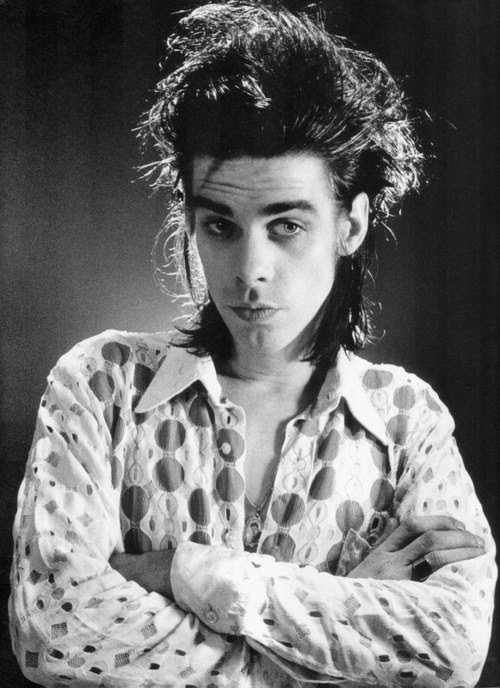 |
| Nick Cave |
Notable examples of goth icons include
several bandleaders: Siouxsie Sioux of Siouxsie and the Banshees, Robert Smith
of The Cure, Peter Murphy of Bauhaus and Dave Vanian of The Damned. Some
members of Bauhaus were, themselves, fine art students or active artists. Nick Cave
Fashion
Gothic fashion is stereotyped as
conspicuously dark, eerie, mysterious, complex and exotic. Typical gothic
fashion includes dyed black hair, dark eyeliner, black fingernails and black
period-styled clothing; goths may or may not have piercings. Styles are often
borrowed from the Elizabethan, Victorian or medieval period and often express
pagan, occult or other religious imagery. Gothic fashion may also feature
silver jewelry.
The New York Times noted: "The
costumes and ornaments are a glamorous cover for the genre's somber themes. In
the world of Goth, nature itself lurks as a malign protagonist, causing flesh
to rot, rivers to flood, monuments to crumble and women to turn into slatterns,
their hair streaming and lipstick askew".
Present-day fashion designers such as John
Paul Gaultier, Alexander McQueen, and John Galliano have also been described as
practising "haute goth".
Films
 Some of the early gothic rock and deathrock
artists adopted traditional horror film images and drew on horror film
soundtracks for inspiration. Their audiences responded by adopting appropriate
dress and props. Use of standard horror film props like swirling smoke, rubber
bats, and cobwebs featured as gothic club décor from the beginning in The
Batcave. Such references in bands' music and images were originally
tongue-in-cheek, but as time went on, bands and members of the subculture took
the connection more seriously. As a result, morbid, supernatural and occult
themes became more noticeably serious in the subculture. The interconnection
between horror and goth was highlighted in its early days by The Hunger, a 1983
vampire film starring David Bowie, Catherine Deneuve and Susan Sarandon. The film
featured gothic rock group Bauhaus performing Bela Lugosi's Dead in a
nightclub. Tim Burton created a storybook atmosphere filled with darkness and
shadow in some of his films like Beetlejuice (1988), Batman (1989), Edward
Scissorhands (1990), and the stop motion films Nightmare Before Christmas
(1993), which was produced/co-written by
Some of the early gothic rock and deathrock
artists adopted traditional horror film images and drew on horror film
soundtracks for inspiration. Their audiences responded by adopting appropriate
dress and props. Use of standard horror film props like swirling smoke, rubber
bats, and cobwebs featured as gothic club décor from the beginning in The
Batcave. Such references in bands' music and images were originally
tongue-in-cheek, but as time went on, bands and members of the subculture took
the connection more seriously. As a result, morbid, supernatural and occult
themes became more noticeably serious in the subculture. The interconnection
between horror and goth was highlighted in its early days by The Hunger, a 1983
vampire film starring David Bowie, Catherine Deneuve and Susan Sarandon. The film
featured gothic rock group Bauhaus performing Bela Lugosi's Dead in a
nightclub. Tim Burton created a storybook atmosphere filled with darkness and
shadow in some of his films like Beetlejuice (1988), Batman (1989), Edward
Scissorhands (1990), and the stop motion films Nightmare Before Christmas
(1993), which was produced/co-written by
As the subculture became well-established,
the connection between goth and horror fiction became almost a cliché, with
goths quite likely to appear as characters in horror novels and film. For
example, The Crow and the Underworld film series drew directly on goth music
and style. The dark comedy Beetlejuice, The Faculty, American Beauty, Wedding
Crashers and a South Park
Books and magazines
The re-imagining of the vampire continued
with the release of Poppy Z. Brite's book Lost Souls in October 1992. Despite
the fact that Brite's first novel was criticized by some mainstream sources for
allegedly "lack[ing] a moral center: neither terrifyingly malevolent
supernatural creatures nor (like Anne Rice's protagonists) tortured souls torn
between good and evil, these vampires simply add blood-drinking to the amoral
panoply of drug abuse, problem drinking and empty sex practiced by their human
counterparts", many of these so-called "human counterparts"
identified with the teen angst and Goth music references therein, keeping the
book in print. Upon release of a special 10th anniversary edition of Lost
Souls, Publishers Weekly—the same periodical that criticized the novel's
"amorality" a decade prior—deemed it a "modern horror
classic" and acknowledged that Brite established a "cult
audience".
Neil Gaiman's acclaimed graphic novel
series The Sandman influenced goths with characters like the dark, brooding
Dream and his sister Death. Mick Mercer's 2002 release 21st Century Goth
explored the modern state of the goth scene around the world, including South America , Japan Asia . His previous 1997 release, Hex Files: The Goth Bible similarly
took an international look at the subculture.
In the US Italy
 |
Zdzisław
Beksiński 1978 oil painting
|
Graphic art
Visual contemporary graphic artists with
this aesthetic include Gerald Brom, Luis Royo, Dave McKean, Trevor Brown,
Victoria Francés as well as the American comic artist James O'Barr. H. R. Giger
of Switzerland
Events
The goth scene continues to exist in 2014.
In Western Europe , there are large annual festivals mainly in Germany Leipzig Hildesheim Finland Ukraine Ghoul School Whitby Fun Park Anaheim , CA
 |
| Androgynous goth |
Since the late 1970s, the UK
Identity
Several observers have raised the issue of
to what degree individuals are truly members of the goth subculture. On one end
of the spectrum is the "Uber goth", a person who is described as
seeking a pallor so much that he or she applies "...as much white
foundation and white powder as possible." On the other end of the spectrum
another writer terms "poseurs": "goth wannabes, usually young
kids going through a goth phase who do not hold to goth sensibilities but want
to be part of the goth crowd..." It has been said that a "mall
goth" is a teen who dresses in a goth style and spends time in malls with
a Hot Topic store, but who does not know much about the goth subculture or its
music, thus making him or her a poseur. In one case, even a well-known
performer has been labeled with the pejorative term: a "number of goths,
especially those who belonged to this subculture before the late 1980s, reject
Marilyn Manson as a poseur who undermines the true meaning of goth."
Media and academic commentary
The goth subculture in the US Columbine High School
According to The Guardian, some goth teens
are at more likely to harm themselves or attempt suicide. A medical journal
study of 1,300 Scottish schoolchildren until their teen years found that the
53% of the goth teens had attempted to harm themselves and 47% had attempted
suicide. The study found that the "correlation was stronger than any other
predictor." The Guardian reported that a "glue binding the [goth]
scene together was drug use"; however, in the goth scene drug use was
varied. Goth is one of the few youth movements that are not associated with a
single drug.
The BBC described academic research that
indicated that goths are "refined and sensitive, keen on poetry and books,
not big on drugs or anti-social behaviour." Teens who are goths will
probably stay in the subculture "into their adult life", and they are
likely to become well-educated and enter professions such as medicine or law.
Dr. Lynne E. Ponton, an adolescent psychiatrist at University of California San Francisco
source WikiPedia
source WikiPedia


