Showing posts with label Sock hop. Show all posts

Saturday, June 20, 2015

Sock hop and Gymnasium

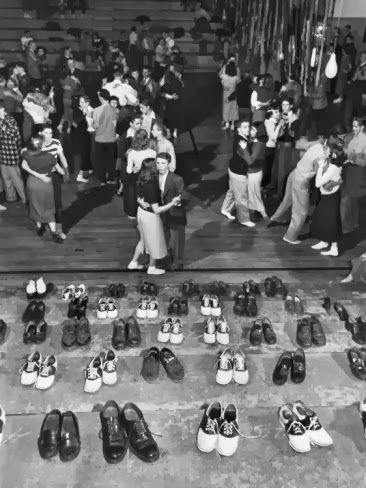
A sock hop or sox hop, often also called a record hop or just a hop, was an informal sponsored dance event for teenagers in mid-20th-century North America, featuring popular music. It was commonly held at high schools and other educational institutions, often in the school gym or cafeteria. The term came about because dancers were required to remove their hard-soled shoes to protect the varnished floor of the gymnasium. The music at a sock hop was usually played from vinyl records, sometimes presented by a disc jockey. Occasionally there were also live bands.

Sock hops were held as early as 1944 by the American Junior Red Cross to raise funds during World War II. They then became a fad among American teenagers in 1948. In later years, "hops" became strongly associated with the 1950s and early rock and roll. Danny and the Juniors sang "At the Hop" in 1957, which named many popular dances and otherwise documented what happened at a hop.
In subsequent decades, with the widespread popularity of sneakers and other types of indoors-only shoes, the practice of removing shoes was dropped. The term then came to be applied more generally to any informal dance for teenagers.

The term caught on in England in the late 1980s during a British rockabilly revival, led by groups like The Stray Cats. "Life Begins at the Hop", a song celebrating sock hops, became the first charting single for XTC.
Gymnasium
A gym, short for gymnasium, is an open air or covered location for gymnastics and athletics and gymnastic services such as in schools and colleges, from the ancient Greek gymnasium.

Gymnasia apparatus such as bar-bells, parallel bars, jumping board, running path, tennis-balls, cricket field, fencing gallery, and so forth are used as exercises. In safe weather, outdoor locations are the most conductive to health. Gyms were popular in ancient Greece. Their curricula included Gymnastica militraria or self-defense, gymnastica medica, or physical therapy to help the sick and injured, and gymnastica athletica for physical fitness and sports, from boxing to dance.

The Greek term gymnasion (γυμνάσιον) was used in Ancient Greece to describe a locality for both physical and intellectual education of young men. The latter meaning of intellectual education persisted in Greek, German and other languages to denote a certain type of school providing secondary education, the gymnasium, whereas in English the meaning of physical education was pertained in the word 'gym'.

The Greek word gymnasium means "school for naked exercise" and was used to designate a locality for the education of young men, including physical education (gymnastics, i.e. exercise) which was customarily performed naked, as well as bathing, and studies. For the Greeks, physical education was considered as important as cognitive learning. Most Greek gymnasia had libraries that could be utilized after relaxing in the baths.

The gyms had halls and colonnades with statues and pictures. These gymnasia also had teachers of wisdom and philosophy. Community gymnastic events were done as part of the celebrations during various village festivals. In ancient Greece there was a phrase of contempt, "He can neither swim nor write." After a while, however, Olympic athletes began training in buildings just for them. Community sports never became as popular among ancient Romans as it had among the ancient Greeks. Gyms were used more as a preparation for military service or spectator sports. During the Roman Empire, the gymnastic art was forgotten. In the Dark Ages there were sword fighting tournaments and of chivalry; and after gunpowder was invented sword fighting began to be replaced by the sport of fencing. There were schools of dagger fighting and wrestling and boxing.

Tuesday, October 1, 2013

SOCK HOP PARTY @ T.R.A.C.S

The text I send in the last group notice was:
TONIGHT, Sock hops became popular in the 1950s. Since dances were often held in school gymnasiums, dancers would often kick of their shoes and dance in their socks or stockings to avoid marking up gym floors and to get better slide in dances like the Twist and the Mashed Potato. Saturday, DJ Racker will let us slide on our socks, playing great music from the 50s.
Especially for this party we lay a new dance floor at T.R.A.C.S.
It was for sure a swinging party. Racker had made a great set of 50s songs. Here are the pictures

OMG ladies, my floor........
Ellbee, Fio and Racker
Racker and Mike
Norbie and I did the twist
Rod
Norbie having a break
Dillon and Simpli
 Gandalle
At the end of the party I gave the girls (names know by management), sandpaper, brushes and clear coat.

Tuesday, September 24, 2013

SOCK HOP chapter II

The sock hop was an informal sponsored dance at American high schools, typically held in the high school's own gym or cafeteria. The term sock hop came about because dancers were required to remove their hard-soled shoes to protect the varnished floor of the gymnasium. These hops were a cultural feature of the 1950s and early rock and roll. The music was usually records, sometimes presented by a disc jockey. Occasionally there were also live bands. Danny and the Juniors sang "At the Hop" in 1957 which named many popular dances and otherwise documented what happened at a hop. The term record hop is generally synonymous with sock hop.

So a sock hop is a dance, often held for teens, that first became popular in the 1950s, when the term was coined. Since dances were often held in school gymnasiums, dancers would often kick of their shoes and dance in their socks or stockings to avoid marking up gym floors and to get better slide in dances like the Twist, the Mashed Potato, and others. Dances held might simply be referred to as sock hops, since the practice was so common.

Several 1950s songs mention this type of dance. Little Richard’s tune Ready Teddy talks about the “sock hop ball,” for example. The most specific reference is the very popular 1958 Danny and the Juniors song At the Hop, describing the regular sock hop scene. Many movies depict these dances as well, most particularly the 1973 George Lucas film American Graffiti.

Ready Teddy lyrics

Ready, set, go man go
I got a girl that I love so

Little Richard
I'm ready, ready, ready Teddy
I'm ready, ready, ready to rock 'n' roll

Going to the corner, pick up my sweetie pie
She's my rock 'n' roll, baby, she's the apple of my eye

I'm ready, ready, ready Teddy
I'm ready, ready, ready to rock 'n' roll

All the flat top cats and all the dungaree dolls
Are headed for the gym to the sock hop ball
The joint is really jumpin', the cats are going wild
The music really sends me, I dig that crazy style

I'm ready, ready, ready Teddy
I'm ready, ready, ready to rock 'n' roll
Going to the corner, pick up my sweetie pie
She's my rock 'n' roll, baby, she's the apple of my eye

I'm ready, ready, ready Teddy
I'm ready, ready, ready to rock 'n' roll

All the flat top cats and all the dungaree dolls
Are headed for the gym to the sock hop ball
The joint is really jumpin', the cats are going wild
The music really sends me, I dig that crazy style

I'm ready, ready, ready Teddy
I'm ready, ready, ready to rock 'n' roll

Gonna kick off my shoes, roll up my faded jeans
Grab my rock 'n' roll, baby, pour on the steam
I shuffle to the left, I shuffle to the right
Gonna rock 'n' roll to the early, early night

I'm ready, ready, ready Teddy
I'm ready, ready, ready to rock 'n' roll
  
In subsequent decades, with the widespread popularity of sneakers and other types of indoors-only shoes, the practice of removing shoes was dropped and the term began to be applied more generally to any informal high school dance. The term caught on in England in the late 1970s during a British rockabilly revival, led by groups like The Stray Cats. Life Begins at the Hop, a song celebrating 'sock hops' became the first charting single for XTC.

What differentiates a sock hop from other dances for teens is that they are informal. They are different from homecoming dances or proms because they’re less dressy and more common events. Dancers didn’t necessarily attend with a partner, unless they were dating someone, and instead they showed up to dance to either live or recorded music. The dance didn’t even have to be held in evening hours, but could instead be held as an afternoon, early evening, or after school event.

Monday, September 23, 2013

SOCK HOP chapter I

At the Hop
"At the Hop" is a hit rock 'n' roll song written by Artie Singer, John Medora, and David White and originally released by Danny & the Juniors. The song was released in the fall of 1957, and reached number one on the US charts on January 6, 1958, thus becoming one of the top-selling singles of 1958. "At the Hop" also hit number one on the R&B Best Sellers list.
The song became more prominent after it was performed by rock and roll revival act Sha Na Na at the 1969 Woodstock Festival and featured in the 1973 coming-of-age teen drama American Graffiti. Musically, it's notable for combining two of the most popular formulas in 1950s rock'n'roll, the twelve-bar blues and the 50s progression.

Background
The song was written by White, Medora and Singer in 1957, when Danny & the Juniors were still called The Juvenairs. Initially called "Do the Bop", the song was heard by Dick Clark, who suggested they change its name. After performing the song on Clark's show American Bandstand, it gained popularity and went to the top of the US charts, remaining at number one for five weeks.

The song describes the scene at a record hop, particularly the dances being performed and the interaction with the disc jockey host.

A sample of the song's lyrics (contemporary popular dances in italics):
 You can rock it you can roll it
 Do the stomp and even stroll it
 At the hop.
 When the record starts spinnin'
 You chalypso and you chicken at the hop
 Do the dance sensation that is sweepin' the nation
 At the hop.

Danny & The Juniors, individually Frank Maffei, Danny Rapp, Joe Terranova and Dave White, began singing together in the early 1950's at ages 13 and 14 in Philadelphia where they were fans of the local rhythm and blues radio stations. It was there they heard the first stirrings of a new music soon to become known as Rock 'n Roll. The Juvenaires, as they were called then, quickly decided to become part of the new movement and began to perform the new songs as well as their own original material at school dances, local clubs and restaurants.

At that time, record companies were engaged in a frenzied search for young people who could perform the new music. It wasn't very long before they discovered the youths, re-named them Danny & The Juniors and recorded them singing one of their own original songs called At The Hop.

What happened next?
Danny & The Juniors went on to have much success.  The group travelled around the U.S., and had additional chart records including PONY EXPRESS and TWISTIN' USA. Dave White eventually left the group to write and produce hit records with John Madara, including Leslie Gore's YOU DON'T OWN ME, Len Barry's 1-2-3 and Chubby Checker's THE FLY, to name a few.
In 1983, Danny Rapp committed suicide, but the Juniors continued working as "Danny & The Juniors, featuring Joe Terry."
In 1992, Danny & The Juniors was inducted into the Hall of Fame and the Walk of Fame in their hometown by the Philadelphia Music Alliance.

In March of 2001, AT THE HOP was voted by the Recording Industry Association of America as one of the top 100 songs of the century. The soundtrack album, “Grease,” was voted one of the top albums of the century.  ROCK AND ROLL IS HERE TO STAY is featured on that album.
In 2003, the group was inducted into the Vocal Group Hall of Fame. 
Along with their numerous television appearances and live performances, Danny & The Juniors had the pleasure of performing at the New York Paramount with Alan Freed and The Apollo in Harlem with Jocko Henderson.
Joe Terry, Frank Maffei and Frank's brother Bobby, continue to perform around the country at conventions, theatres, clubs, casinos, fairs and festivals. Dave White continues to write and produce for various artists.

DANNY AND THE JUNIORS
 "At The Hop"

Bah-bah-bah-bah, bah-bah-bah-bah
Bah-bah-bah-bah, bah-bah-bah-bah, at the hop!

Well, you can rock it you can roll it
You can slop and you can stroll it at the hop
When the record starts spinnin'
You chalypso when you chicken at the hop
Do the dance sensation that is sweepin' the nation at the hop

Ah, let's go to the hop
Let's go to the hop (oh baby)
Let's go to the hop
Come on, let's go to the hop

Well, you can swing it you can groove it
You can really start to move it at the hop
Where the jockey is the smoothest
And the music is the coolest at the hop
All the cats and chicks can get their kicks at the hop
Let's go!

Ah, let's go to the hop
Let's go to the hop (oh baby)
Let's go to the hop
Come on, let's go to the hop
Let's go!

[Instrumental Interlude]

Well, you can rock it you can roll it
You can slop and you can stroll it at the hop
When the record starts spinnin'
You chalypso* when you chicken at the hop
Do the dance sensation that is sweepin' the nation at the hop

Well, you can swing it you can groove it
You can really start to move it at the hop
Where the jockey is the smoothest
And the music is the coolest at the hop
All the cats and chicks can get their kicks at the hop
Let's go!

Ah, let's go to the hop
Let's go to the hop (oh baby)
Let's go to the hop
Come on, let's go to the hop
Let's go!

Bah-bah-bah-bah, bah-bah-bah-bah

Bah-bah-bah-bah, bah-bah-bah-bah, at the hop!